


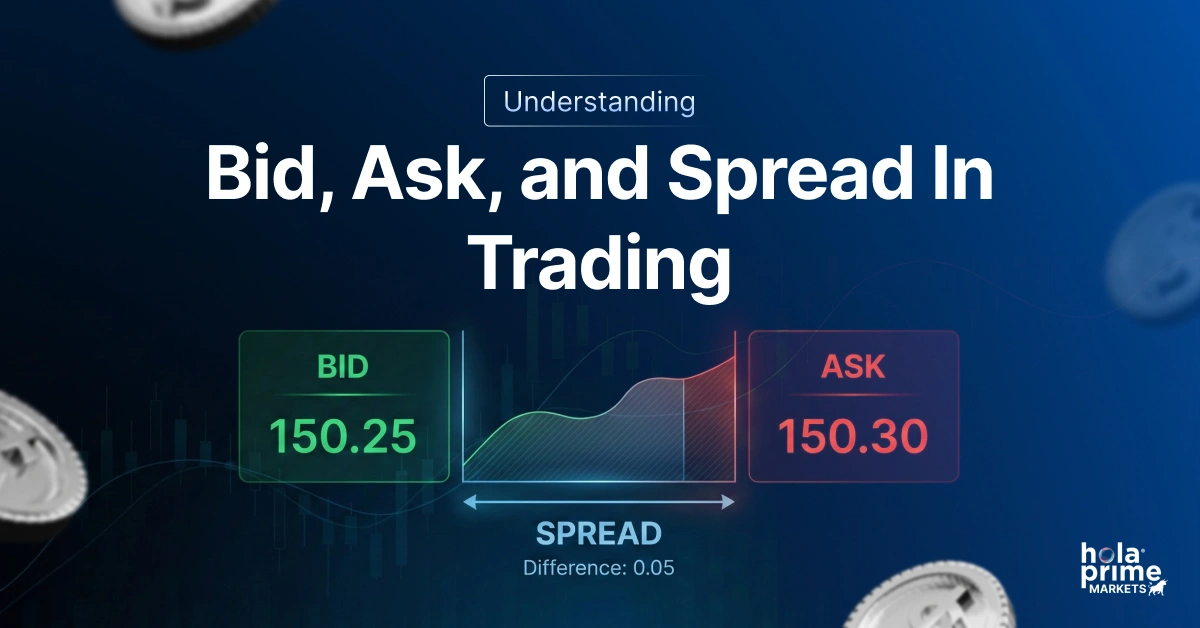
If you’ve ever opened a trading platform and thought:
“Why are there two prices?”
“Why did my trade start with a small loss?”
“What exactly is this spread everyone keeps talking about?”
You’re not alone.
Bid, ask, and spread confuse almost every new trader at first. And honestly, most explanations out there make it sound more complicated than it really is.
Let’s break it down slowly, clearly, and in plain English, so it actually makes sense.
The Two Prices You Always See: Bid and Ask
When you look at any market – forex, indices, crypto, commodities – you’ll always see two prices instead of one.
Those two prices are:
- Bid
- Ask
They exist for a simple reason:
One price is for selling, and the other is for buying.
What Is the Bid Price in Trading?
The bid price is:
The price at which the market is willing to buy from you.
In other words:
- If you want to sell immediately, you sell at the bid price.
Think of it as:
“What buyers are currently offering.”
What Is the Ask Price in Trading?
The ask price is:
The price at which the market is willing to sell to you.
In other words:
- If you want to buy immediately, you buy at the ask price.
Think of it as:
“What sellers are asking for.”
A Simple Example (This Makes It Click)
Let’s say you’re looking at gold:
- Bid: 2,000.00
- Ask: 2,000.50
If you:
- Buy, you enter at 2,000.50
- Sell, you enter at 2,000.00
That difference between the two prices is important, and it leads us to the spread.
What Is Spread in Trading?
The spread is simply:
The difference between the ask price and the bid price.
Using the same example:
- Ask: 2,000.50
- Bid: 2,000.00
Spread = 0.50
That’s it. No mystery.
Why Does the Spread Exist?
Spreads exist because markets need:
- liquidity
- order matching
- intermediaries to function smoothly
For traders, the spread is essentially the cost of entering a trade.
This is why:
- Your trade often starts slightly negative
- Price needs to move a bit in your favor before you see a profit
How Bid, Ask, and Spread Affect Your Trade Immediately
The moment you enter a trade:
- A buy trade starts at the ask price
- A sell trade starts at the bid price
When you close the trade:
- Buy trades close at the bid
- Sell trades close at the ask
That gap – the spread – is crossed twice:
- once on entry
- once on exit
That’s why spreads matter, especially for short-term traders.
Why Spread Matters More for Some Traders Than Others
Not all traders feel the spread equally.
Scalpers and Day Traders
Spreads matter a lot.
- Small targets
- Many trades
- Tight margins
Even a slightly wider spread can affect profitability.
Swing and Position Traders
Spreads matter less.
- Larger price targets
- Longer holding time
For these traders, spread is a small cost compared to the move they’re aiming for.
What Causes Spreads to Change?
Spreads aren’t always fixed. They can widen or tighten depending on:
- market volatility
- trading session
- major news events
- liquidity levels
For example:
- During high-impact news, spreads often widen
- During calm, liquid sessions, spreads stay tight
This is normal – not manipulation.
Tight vs Wide Spreads: What’s Better?
In general:
- Tighter spreads = better for traders
- Wider spreads = higher trading cost
This is why many traders choose brokers and platforms known for:
- strong liquidity
- stable execution
- consistent spreads
A Common Beginner Mistake With Bid and Ask
Many new traders think:
“Price hasn’t moved, but I’m already losing.”
What’s actually happening?
- You entered at the ask
- You’re seeing the bid price
That small gap is the spread – not a bad trade.
Once you understand this, a lot of confusion disappears.
How to Trade Smarter With Spreads in Mind
Here are a few practical tips:
- Avoid trading during major news if you’re new
- Focus on liquid markets
- Don’t scalp wide-spread instruments
- Always factor spread into your risk–reward
- Use limit orders when appropriate
Small adjustments like these make a big difference over time.
Final Thoughts: Bid, Ask, and Spread Are Not the Enemy
Bid, ask, and spread aren’t tricks designed to confuse you.
They’re just how markets work.
Once you understand:
- who’s buying
- who’s selling
- what it costs to enter a trade
You stop feeling lost and start trading with confidence.
And confidence, paired with discipline, is where real progress begins.